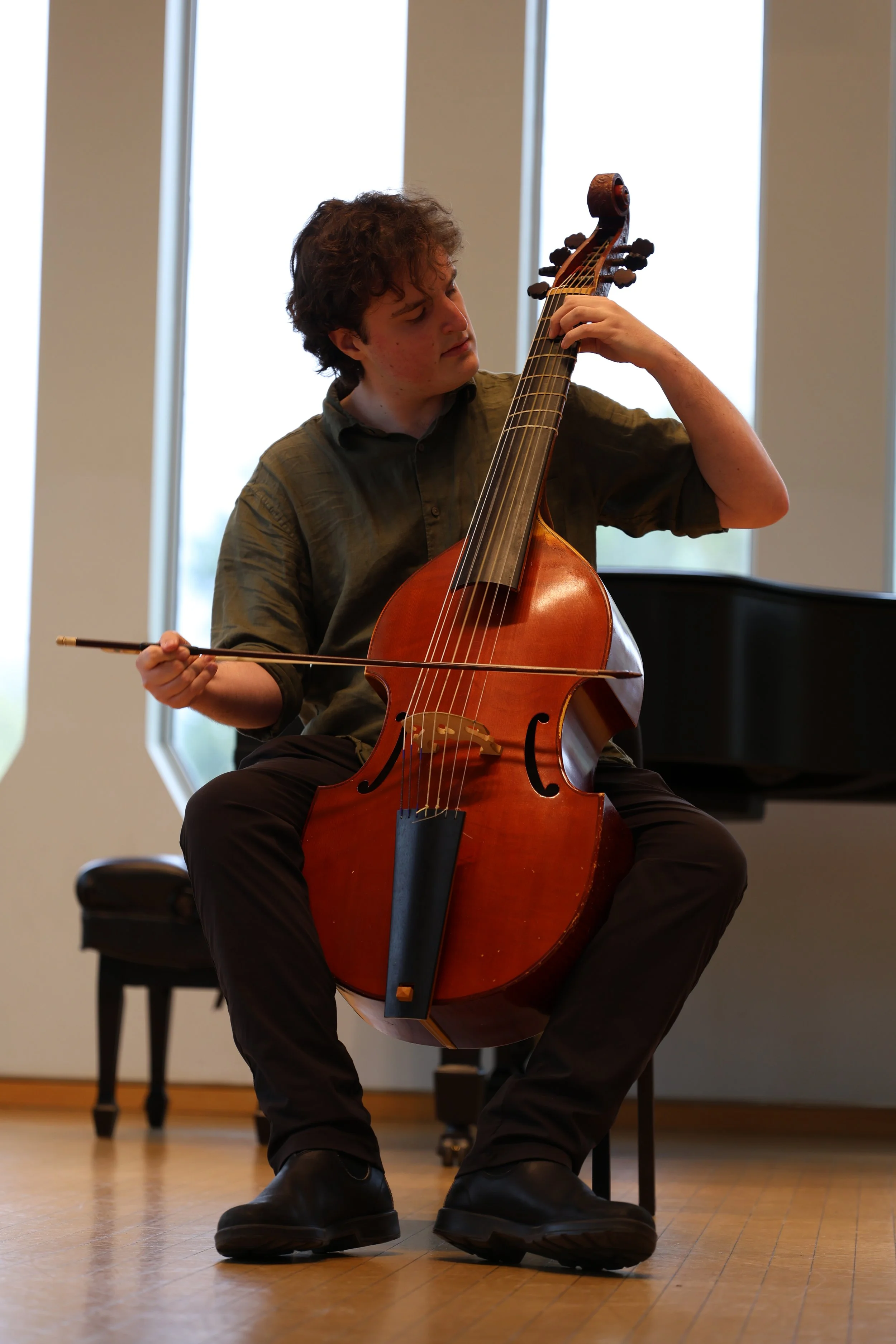
Photo by Michael Frazier
Aaron Nichols
Composer, Performer, Orchestrator
Featured compositions
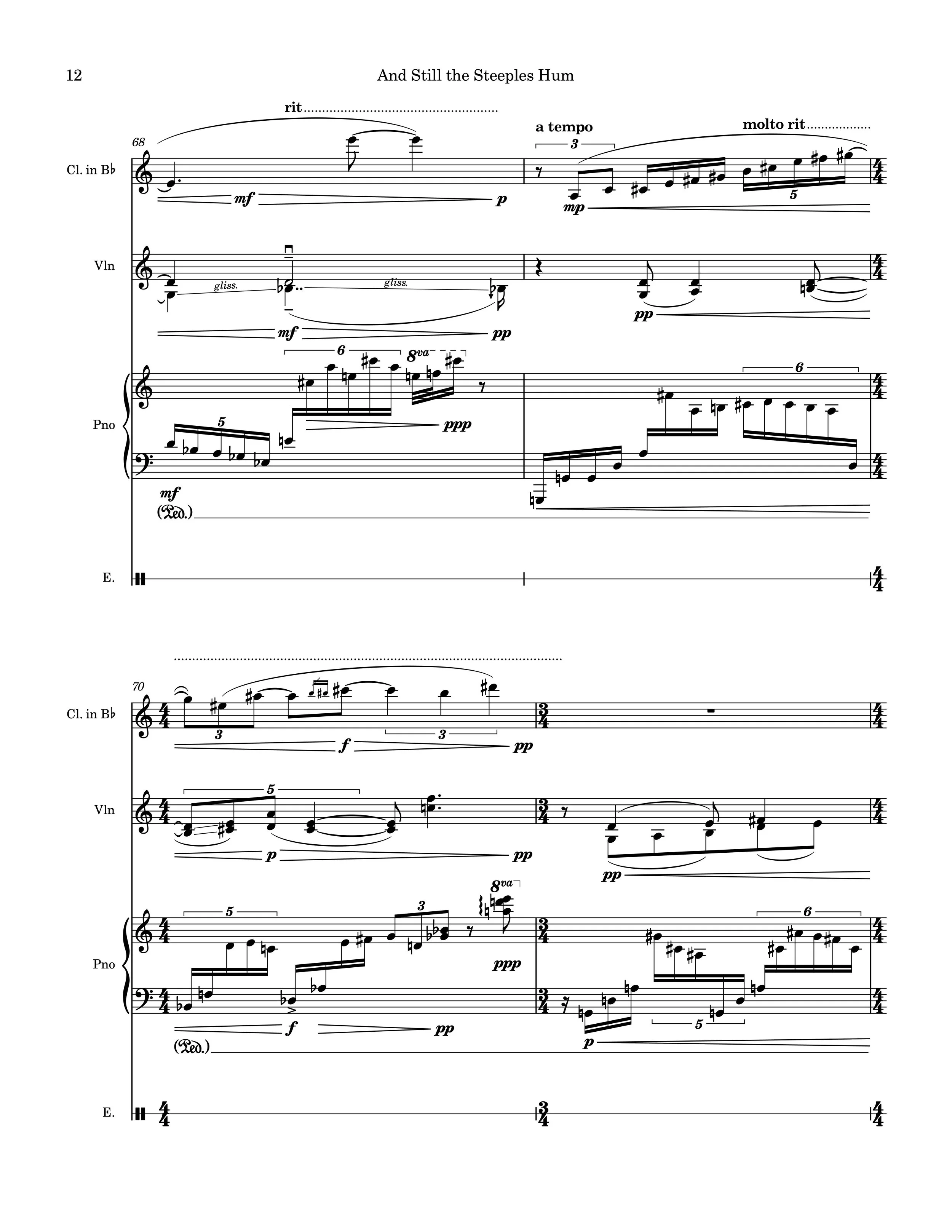
And Still the Steeples Hum
For the last nine months, I have had a certain fixation with A. E. Housman’s “Bredon Hill,” as well as Ralph Vaughan Williams’s setting of it. The poem draws an analogy between church bells ringing on Bredon Hill and the narrator’s loss of a lover. The connection between the bells and the narrator’s memories of this lover is utterly inextricable: their hoped wedding is symbolized, as well as the lover’s sudden death, and funeral. The bells are at once a source of fond memory, and of bitter torment.
In “And Still the Steeples Hum,” I write somewhat in response to Houseman and Vaughan Williams. Similarly to Vaughan Williams, this piece is cyclical: similarly to Vaughan Williams, this piece derives much of its textural language from an onomatopoeic treatment of the bells. My primary clarinet theme, furthermore, pays direct homage to the soloist’s main melody in Vaughan Williams’s setting: however it is presented with greater hesitation, and with the clangor of the bells in the background. If Vaughan Williams’s “Bredon Hill” is a straightforward emotional release, “And Still the Steeples Hum” is a panic attack.
“And Still the Steeples Hum” was written for Unheard-Of Ensemble, who premiered and recorded the work on November 14th, 2025 in Oberlin, Ohio.
Mesovortex
Mesovortex is inspired by, and structured loosely around time lapse footage of tornadogenesis. When sped up, one can clearly see the ordinary cloud formations caught in an inexorable, yet invisible pull towards themselves–one that is less obvious in real time. This process feels analogous to the unraveling of human emotions: normal events, aligned properly, can grind against one-another, creating anger or fear out of virtually nothing. The piece takes advantage of the saxophone quartet’s capacity to melt into itself–to form more of a mercurial, polyphonic plasma than four distinct voices.
The primary textural goal, throughout this piece, is to create a frenetic, micropolyphonic soup. With a few exceptions, (soli, sudden changes, lines should feel as though they emerge from the overarching texture.
Mesovortex was written for PRISM quartet, in a joint commission by the quartet and the Walden School (Dublin NH.) It was premiered on November 17th, 2024 in Philadelphia, and performed again and recorded in New York the following day.

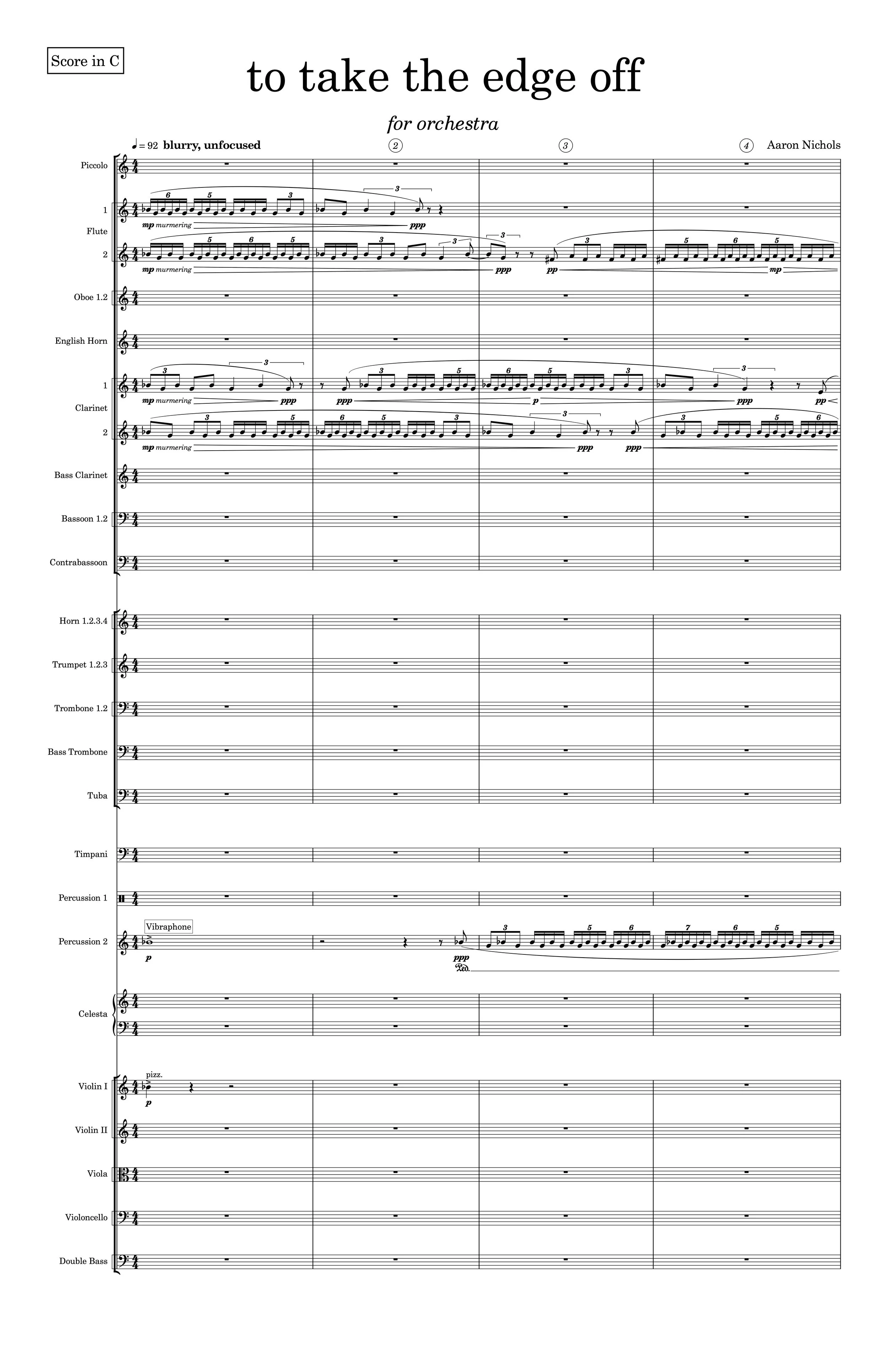
To take the edge off
"To Take the Edge Off" attempts to convey a feeling of transience in harmony, texture, and form. The harmonic language of the piece favors octatonic and hexatonic collections, whose symmetrical structures avoid harmonic "edges," and support the shimmering, mercurial textures that are present throughout. The idiom to take the edge off describes the temporary alleviation of something uncomfortable, be it hunger, cold, or physical or emotional pain. As I wrote the piece, I thought of this concept, and of the futility of trying to find short answers to complex problems: an easy fix will usually only serve to obscure the truth, and not to grapple with it.
I view the piece as a series of episodes, or variations on a couple essential musical ingredients: a twelve-tone row, a minor third embedded in that twelve-tone row, and the uncomfortable coexistence of octatonicism, hexatonicism, and the implications of triadic harmony. As it wanders through this hazy harmonic landscape, the music struggles to find a sense of where it is, or where it truly wants to be.
To Take the Edge Off was read by the Oberlin Orchestra on November 1st, 2024.
The Water Understands
Throughout my time at Oberlin, starting from my first TIMARA classes, I have written several pieces that have taken some inspiration, conceptually and sonically, from the sound-walks taught in the TIMARA curriculum, and the work, as well, of Hildegard Westerkamp. Westerkamp was a student, and later a colleague, of R. Murray Schafer, one of the founders of acoustic ecology, and one of Canada’s leading composers in his time – they worked together, along with Barry Truax, John Oswald, and many others on the World Soundscape Project, a project dedicated to recording and documenting acoustic environments around the world, in favor of cataloguing and analyzing these sounds, and raising awareness of the effects of noise pollution, and of human disruption to the sonic environment. The term “Soundwalk,” as well as the practice it represents, emerged during the World Soundscape Project, and the concept had a lasting enough impression on Westerkamp to inform much of her work as a composer, perhaps most notably in the composition Kits Beach Soundwalk, in which she uses equalization to strip back layers of sound to reveal the barely-audible barnacles suckling on the rocks of the beach underwater.
Given the not-insignificant Schaferian/Westerkampian rabbit-hole my time at Oberlin wrought in my life, much of my acoustic and electronic music in the last several years have taken great inspiration both from a musical depiction of my physical surroundings, and a relationship between these surroundings and my emotions. The pieces that make up “The Water Understands” lie soundly within this influence, with three of them heavily featuring sounds recorded around specific sources of water at Oberlin (the pond outside the environmental science center in “Pseudacris Crossing”, the koi pond outside the conservatory in “A Hand in a Garden Pond”, and the plum creek and reservoir in the Arboretum in “Ill-Used”). Mixed in with these are synthesizers (analogue and digital), theremin, piano (comprising the primary source of “Wellspringklavier” and “Disconcerted; Broken-Hearted”, violin (performed by Sophie DeLong), and my own singing voice. Disconcerted; Broken-Hearted and Ill-Used both have been subjects of audio-visual treatments – at some point, I would like to create similar versions of the first three compositions.
The Water Understands: Audio
Ill-Used
Disconcerted; Broken-Hearted
Pale Orange Circles
Starting in my fourth semester in college, inspired loosely by Pamela Z and Thom Yorke, in very different ways, I began to write several pieces for live performance, making primary use of delays, pitch-shifting, looping, and other similar forms of processing on my own voice. Most of these pieces are vocalises, with the exception of the middle two, which are (in various degrees) songs. The songs in question are meditations on my own childhood experience as an autistic kid in the NYC public school system, mixed as well with images from my current state in college.
“Ode to Behavioral Engineering” is a direct response to instructions of classroom etiquette and self-containment that, I feel, had a long-term and detrimental effect on my learning, and my capacity to engage: primarily sung instructions to “stop, look, and listen,” to sit “criss-cross applesauce,” and orders to avoid talking out of turn, and engage in mental processes only internally – to “think inside my head.” These ideas demonstrate a perfect framework for putting on the appearance of an engaged, respectful, and well-behaved student – and they are, in a sense, essential to maintain a classroom: if one voice, or one presence unduly dominates a space, then it becomes difficult for everyone else to chip in. But from my perspective, it taught me to lock away my curiosity, my engagement, and my willingness to stick up for myself and others. That those actions, disruptive to everyone else, were tied with essential components of expression for me, make the feeling of reclaiming them feel impossible even to this day.
“I Wanna Run” describes a feeling best encapsulated by the title: the desire to run away from a feeling of rigid confinement within social structures that make me feel trapped. This straightforward desire dangerously slips into a darker one: to run away from responsibility, from my own emotions and actions, from my experience, from my very self. The words throughout the piece are repeated and distorted and broken up, in an ever-present rhythmic pulse almost imitative of the act of running: or of the feeling of runaway thoughts. The piece further relates to my discovery of my autism diagnosis, when I was 10 – I had been diagnosed when I was two. The discovery of this diagnosis resulted from my parents telling me about the disappearance of a nonverbal autistic boy, Avonte Oquendo, after he ran unattended out of an NYC public school: in telling me about Avonte, and explaining to me as best they could what autism was, my parents revealed to me that I too was diagnosed with the same condition that he had, though I was “a less severe case.” I recall an intense fixation with the progress of that story at the time – with any hint that this child was still alive – and the sinking in my chest when I heard that his death was confirmed. Lastly I recall a feeling – one that I had felt long before I knew I was autistic, and before anyone had clearly articulated it to me, and one that I can only imagine Avonte shared: that we were “different,” and everyone knew it, and nobody knew precisely how to handle it – a feeling that no amount of love and care could quite shake. Neurotypical social structures, and in particular those found in most schools, simply were not built to handle the differences in mental processing, thought, and outward expression of autistic children: the onus is typically on us to adapt as best we can, unless a barrier is so strong
These pieces were written and compiled over about a semester, and by and large recorded in one take. I have since made a performing version of this and done it live in all or in part. It was done in VCV Rack, particularly making use of the “Chronoblob 2” delay module, which allowed for a sort of runaway feedback that breaks up and distorts the sound, in such a way that I have yet to figure out how to exactly recreate in any other form.